
Oil binding agents are an indispensable tool in the fight against unwanted oil contamination in the environment
What are oil binding agents?
Oil absorbents are materials used to absorb and bind spilled oil or other hydrophobic liquids. They are crucial for dealing with environmental spills and come in various forms such as granules, powders and liquids. Their application ranges from cleaning up small spills to combating large oil spills, with the choice of oil binding agent depending on the type of oil, the quantity and the environment.

What types of oil binding agents are there and what are they made of?
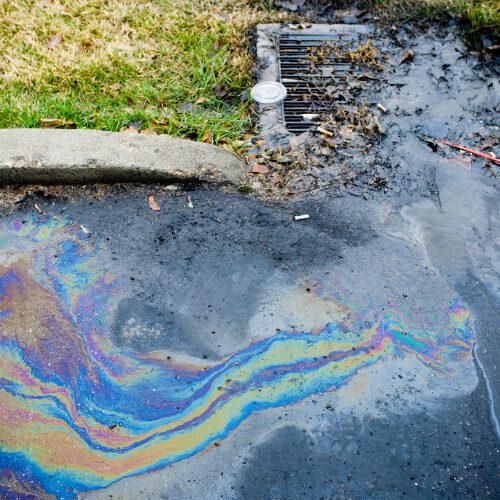
There are two main types of oil binders: adsorbent (granules) and absorbent (liquid binders and mats). Granules are often based on natural substances such as clay, diatomaceous earth or modified polymers that bind oil on their surface. Liquid oil binders, on the other hand, trap the oil in their structure and are often based on biodegradable substances, which makes them particularly environmentally friendly.
Liquid oil binding agents to restore road safety
How do liquid oil binding agents differ from granulates in their application?
Liquid oil binding agents offer specific advantages over granulates. They are easy to use as they can be sprayed directly onto the oil and spread quickly over the entire contaminated surface, enabling efficient and rapid absorption. In addition, liquid binders can reach hard-to-reach places and spaces, making them ideal for complicated spill situations. Granules, on the other hand, are better suited for large-area contamination on solid surfaces, but can be less controllable in wind and weather.
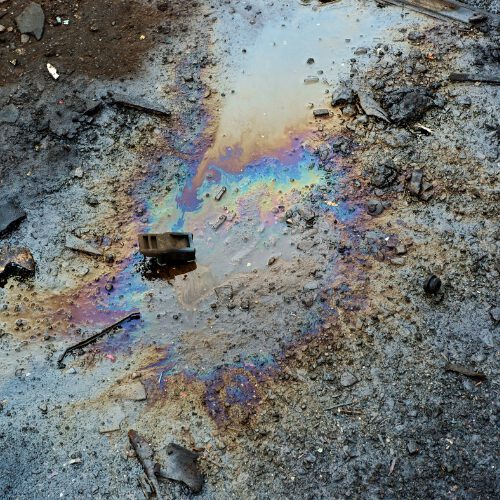
Why are liquid oil binding agents often more efficient than granulates?
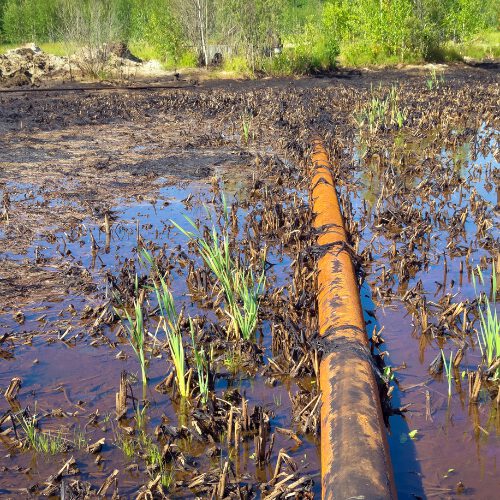
Liquid oil absorbents offer a decisive advantage in the immediate and effective response to oil spills due to their rapid distribution and ability to reach hard-to-reach areas. Granules, on the other hand, are valuable due to their ease of application and suitability for large-scale clean-up operations, especially when time is less of a critical factor. The choice of the appropriate oil binding agent ultimately depends on the specific contamination situation and the given environmental conditions.
The most important points summarised
Oil absorbents are essential tools in environmental protection, especially when it comes to combating oil spillages. They play a crucial role in industries where oil and chemical spills are common, such as petrochemicals, transport and manufacturing. These agents are used to effectively absorb and bind spilled oil and other hydrophobic liquids to minimise environmental damage and facilitate clean-up.
There are two main types of oil binders: solid and liquid. Solid oil absorbents, often in the form of granules or powders, absorb oil through direct contact by adsorbing it onto their surface. These are particularly useful for large spillages on solid surfaces and are easy to use as they are spread over the contaminated area.
Liquid oil binding agents, on the other hand, offer specific advantages that make them more effective in many scenarios. These binding agents are sprayed directly onto the spilled oil and can spread quickly and evenly over the affected area. Their liquid form allows for more complete coverage of the oil and an immediate response, which is especially critical in emergency situations. Here are some of the main advantages of liquid oil absorbents over solid ones:
- Faster responseLiquid oil binding agents can react more quickly to the oil due to their application method. They can be used immediately and start absorbing the oil straight away, which reduces the possibility of further spreading and deeper penetration into the ground.
- Better accessibilityLiquid binders can be used in areas that are inaccessible to solid granules. They are ideal for uneven surfaces, under machinery, in cracks and on water, where they can form a continuous surface that effectively encapsulates the oil.
- Efficient absorption and insulationLiquid oil absorbents are usually formulated to have a high affinity for oils. They not only absorb the oil, but also effectively isolate it from the environment, which makes cleaning easier and minimises the environmental impact.
- Less waste and easy handlingAs they can be applied in targeted and precisely dosed quantities, liquid oil binding agents generally generate less waste than granulates. This reduces disposal costs and facilitates handling during the cleaning process.
- Applicability to waterMany liquid oil absorbents are specially designed for use on water. They can absorb and stabilise floating oil, making them a valuable resource for cleaning up oil spills on bodies of water.
To summarise, liquid oil absorbents offer significant advantages over solid granules due to their rapid dispersion, effective absorption and versatility. They are particularly suitable for rapid deployment and difficult conditions, making them a favoured choice for many industries and environmental protection measures. Their environmentally friendly formulations and efficient cleaning properties make them an indispensable tool in modern oil spill response and environmental remediation.
Frequently asked questions
What are oil binding agents?
Oil absorbents are substances used to absorb and isolate spilled oil in order to prevent environmental damage.
What types of oil binding agents are there?
There are two main types: solid granules and liquid binders. Both have specific areas of application and advantages.
How do you use liquid oil binding agents?
Liquid oil binding agents are sprayed directly onto the spilt oil to enable quick and effective absorption.
Are liquid oil binding agents better than granulates?
Liquid oil binding agents provide quick coverage and reach hard-to-reach areas, but are often more efficient than granulates depending on the situation.
How do you dispose of used oil binding agents?
Used oil binding agents should be treated and disposed of in accordance with local environmental guidelines in order to avoid further environmental pollution. Exceptions are liquid oil binding agents, which do not have to be disposed of in certain cases.
Our products
Minimum order quantity: 20 x 10-litre canisters. Other packaging available on request.
10-litre canisters, 600-litre IBCs and 1,000-litre IBCs. Other containers available upon request.
10-litre canisters, 600-litre IBCs and 1,000-litre IBCs. Other containers available upon request.
10-litre container. Further containers available on request.
10-litre canisters, 600-litre IBCs and 1,000-litre IBCs. Other containers available upon request.
10-litre canisters, 600-litre IBCs and 1,000-litre IBCs. Other containers available upon request.
10-litre canisters, 600-litre IBCs and 1,000-litre IBCs. Other containers available upon request.