
What makes biosurfactants so special - 100 % native raw materials
Basic information about biosurfactants
Manufacture
Biosurfactants are a special type of surfactant obtained from natural sources such as microorganisms, plants or animal products. Surfactants are surface-active substances that can reduce the surface tension of liquids. They are found in many everyday products, including Cleaning agents, shampoos, cosmetics, food and pharmaceutical products.
In contrast to synthetic surfactants, which are often produced from petrochemical sources, biosurfactants are produced through biotechnological processes. These processes utilise microorganisms such as bacteria, yeasts or fungi, which have the ability to produce surfactants as part of their metabolism.
Application
Biosurfactants have a variety of applications and are attractive due to their natural origin and potentially lower environmental impact. They are used in detergents, cosmetics, food additives, pharmaceutical products and many other applications.
Properties
The properties of biosurfactants can vary depending on their specific chemical structure, but in general they have surface-active properties that help them to improve the wetting of surfaces, stabilise emulsions and form foam. They are also often considered more biodegradable and less toxic than some synthetic surfactants, making them a more environmentally friendly alternative in many applications.

The difference between biosurfactants and other surfactants
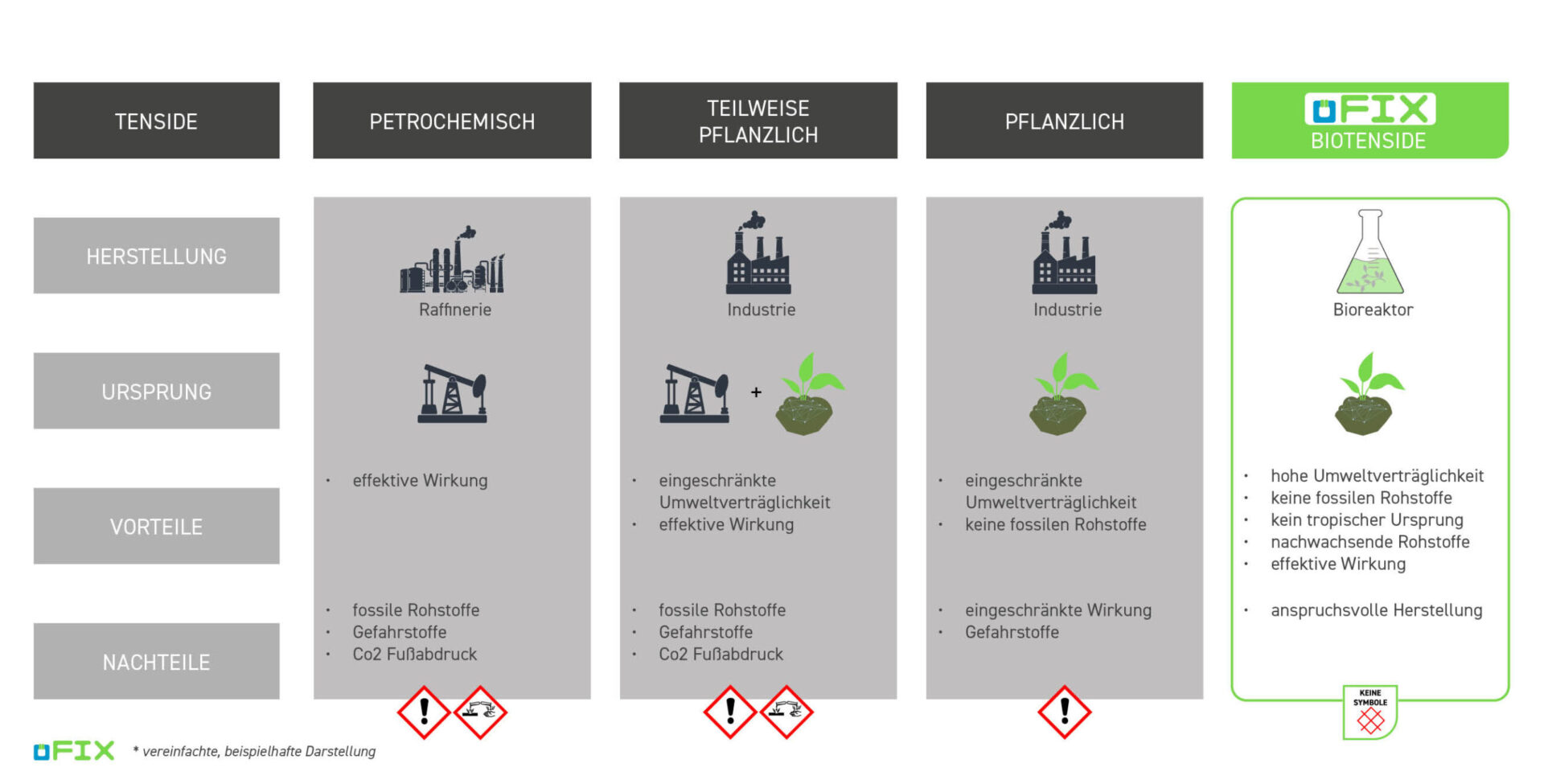
Biosurfactants and other surfactants differ mainly in their origin, their chemical structure, their properties and their potential impact on the environment.
Here are some of the main differences:
- Origin: Biosurfactants are derived from natural sources such as microorganisms, plants or animal products, while other surfactants are often produced synthetically and can come from petrochemical sources.
- Manufacturing process: Biosurfactants are typically produced through biotechnological processes that use microorganisms to produce the surfactants as part of their metabolism. Synthetic surfactants, on the other hand, are usually produced by chemical synthesis.
- Chemical structure: The chemical structure of biosurfactants can vary depending on the microorganisms from which they are obtained. However, they often consist of a hydrophilic head and a hydrophobic tail, similar to other surfactants. Synthetic surfactants can have a wide range of chemical structures, depending on their manufacturing processes.
- Environmental compatibility: Biosurfactants are often considered more environmentally friendly than synthetic surfactants as they are of natural origin and tend to be more biodegradable. They also often have lower toxicity and can therefore have less harmful effects on the environment.
- Properties: Biosurfactants have similar surface-active properties to other surfactants, including the ability to reduce the surface tension of liquids, stabilise emulsions and form foam. However, the specific properties can vary depending on the chemical structure.
Liquid oil binding agents to restore road safety
Powerful cleaning performance of the biosurfactants
Biosurfactants have a good cleaning effect due to their surface-active properties and their ability to reduce the surface tension of liquids.
Here are some reasons why biosurfactants have an effective cleaning effect:
- Wetting ability: Biosurfactants can help water to penetrate fine pores and gaps more efficiently, making it easier to wet surfaces. This enables better removal of dirt particles and impurities.
- Emulsifying properties: Biosurfactants have the ability to disperse and emulsify both hydrophobic (greasy) and hydrophilic (water-soluble) substances. This enables them to suspend oils, fats and other poorly soluble impurities in water and remove them effectively.
- Releasing power: Due to their structure, biosurfactants can destabilise compounds on the surface of dirt particles and then effectively suspend them in water. This increases the efficiency of cleaning various surfaces.
- Foam formation: Some biosurfactants have the ability to generate abundant foam, which is often associated with an improved cleaning effect. The foam can help to loosen and remove dirt particles by rinsing them away from the surface.
- Low residues: Organic surfactants tend to leave less residue than some synthetic surfactants, which helps to leave surfaces cleaner.
- Environmental compatibility: Biosurfactants are often biodegradable and less toxic to humans and the environment compared to some synthetic surfactants. This makes them a more environmentally friendly option for cleaning purposes.
Overall, they combine the surface-active properties of biosurfactants with their biodegradability and low toxicity to achieve an effective and environmentally friendly cleaning effect.

The most important properties of biosurfactants

Biosurfactants have a variety of properties that make them useful in different applications. Some of the most important properties of biosurfactants are
- Surface activity: Biosurfactants have surface-active properties that enable them to reduce the surface tension of liquids. As a result, they can help to improve the wetting of surfaces and stabilise emulsions.
- Emulsifying properties: Biosurfactants can be used to stabilise oil-in-water or water-in-oil emulsions. They can help to disperse oils and fats in water and thus facilitate the production of emulsions in various applications.
- Foam formation: Some biosurfactants have the ability to form foam, which makes them useful in detergents and cosmetic products, where foam is often associated with cleansing power.
- Biodegradability: Biosurfactants are made from natural sources and are therefore often biodegradable. This makes them a more environmentally friendly alternative to synthetic surfactants, which can often remain in the environmental cycle for longer.
- Less toxic: In general, biosurfactants are considered safer and less toxic to humans and the environment compared to some synthetic surfactants. They can therefore be used in applications where lower toxicity is desirable, such as in cosmetics or household cleaning products.
- Versatility: Biosurfactants can be used in a variety of applications, including detergents, cosmetics, food additives, pharmaceuticals and more. Their versatility makes them an attractive option for various industries.
Overall, biosurfactants offer a number of favourable properties that can make them an attractive alternative to synthetic surfactants, especially in applications where environmental compatibility and safety are important.
Biosurfactants - The most important facts summarised
In the detergent industry, biosurfactants are valued for their environmentally friendly properties and their effectiveness at low concentrations. They are able to emulsify fats, oils and other hydrophobic contaminants, making them easier to remove. This makes them ideal for use in household and industrial cleaners as well as in personal care products such as shampoos and shower gels. Their mild nature makes them particularly suitable for formulating products for sensitive skin or for applications where a low environmental impact is required.
Use in liquid oil binding agents
Liquid oil absorbents, which are often used to combat oil spills, also benefit from the properties of biosurfactants. These substances can effectively help break up oil slicks on bodies of water by breaking down the oil droplets into smaller particles, which can then be more easily biodegraded or mechanically removed. The use of biosurfactants in such scenarios offers an environmentally friendly alternative to conventional methods, which often involve harmful chemical surfactants.
In addition, biosurfactants are able to penetrate hard-to-reach oil spills, making them particularly effective in porous materials such as sand and soil. This property is particularly valuable in the clean-up of oil-contaminated land areas and beaches.
Environmental and economic benefits
The environmentally friendly properties of biosurfactants, including their biodegradability and low toxicity, make them a favoured choice over petrochemical surfactants. They can often be produced from renewable resources, helping to reduce dependence on fossil fuels. Economically, biosurfactants offer advantages due to their effectiveness at low doses and the possibility of utilising local biomass potential.
To summarise, biosurfactants are a promising alternative in the world of surfactants, especially in applications such as cleaning concentrates and liquid oil binders, where environmental compatibility and efficiency are required. Their diverse applications and advantages position them as a key component in the sustainable chemistry of the future.
What are biosurfactants and how are they produced?
Biosurfactants are surface-active substances of biological origin that are produced by microorganisms such as bacteria, yeasts and fungi. These substances can reduce the surface tension between two liquids or between a liquid and a solid. They are usually produced by fermentation processes in which these microorganisms process renewable raw materials such as vegetable oils or sugar molasses.
Why are biosurfactants particularly suitable for the cleaning industry?
Biosurfactants offer decisive advantages for the cleaning industry: their ability to clean effectively, their environmental compatibility and their safety for humans. They are able to emulsify fats and oils, making them ideal for the production of degreasers and speciality cleaners such as liquid oil binders. Their biodegradability reduces the risk of environmental damage, while their low toxicity makes them safe for use in products that come into direct contact with the skin.
What advantages do biosurfactants offer over conventional surfactants in cleaning products?
Biosurfactants outperform conventional surfactants in several aspects:
- Environmental friendliness: They are completely biodegradable and reduce the risk of environmental pollution.
- Health compatibility: Biosurfactants are less toxic and irritating to the skin than many synthetic surfactants.
- Efficiency: They are often more effective at removing dirt and oils, even in low concentrations.
How are biosurfactants used in the cleaning industry?
Biosurfactants are used in many different ways in the cleaning industry. They are used in
- speciality cleaners: For demanding cleaning tasks, such as removing stubborn oil and grease stains, biosurfactants offer an effective and environmentally friendly solution.
- All-purpose cleaners: For effective cleaning of various surfaces without harmful chemicals.
- Dishwashing detergents: They efficiently dissolve fats and food residues without irritating the skin.
- detergents: Biosurfactants improve washing performance at low temperatures and are gentle on colours and fibres.
What other areas of application are there for biosurfactants?
Whilst biosurfactants play an important role in the cleaning industry, they are also used in a variety of other areas, including:
- Agriculture (as biological pesticides)
- Food industry (as emulsifiers)
- Pharmaceutical industry (for the formulation of medicines)
- Cosmetics industry (for skin-friendly cleaning products)
- Environmental technology (for the remediation of oil-contaminated sites)
Our products
Minimum order quantity: 20 x 10-litre canisters. Other packaging available on request.
10-litre canisters, 600-litre IBCs and 1,000-litre IBCs. Other containers available upon request.
10-litre canisters, 600-litre IBCs and 1,000-litre IBCs. Other containers available upon request.
10-litre container. Further containers available on request.
10-litre canisters, 600-litre IBCs and 1,000-litre IBCs. Other containers available upon request.
10-litre canisters, 600-litre IBCs and 1,000-litre IBCs. Other containers available upon request.
10-litre canisters, 600-litre IBCs and 1,000-litre IBCs. Other containers available upon request.